Start with your hob manual before choosing a protector

Product feature overview

The safest first step when researching an induction hob protector uk is to check your hob manufacturer’s instructions before buying or placing any mat on the appliance. Look specifically for guidance about covers, mats, accessories, ventilation, surface clearance and warranty conditions. This product is described as a cover for use when the hob is off; the supplied information does not establish that it is suitable during cooking, that it can stay in place while a zone is heating, or that it preserves pan detection. If your manual does not clearly permit a protective cover, contact the manufacturer or choose not to use one.

That check matters because induction hobs differ in their glass layout, controls and manufacturer instructions. A mat that appears to fit a round cooking zone may still be unsuitable for your particular appliance or intended use. Treat the product description and your appliance manual as two separate checks: the listing tells you what the five-piece set contains, while the manual tells you what your hob permits. This approach is especially useful if you are concerned about marks from cookware, moving a heavy casserole, or covering the surface between cooking sessions.

Match the five pieces to the glass hob in your kitchen

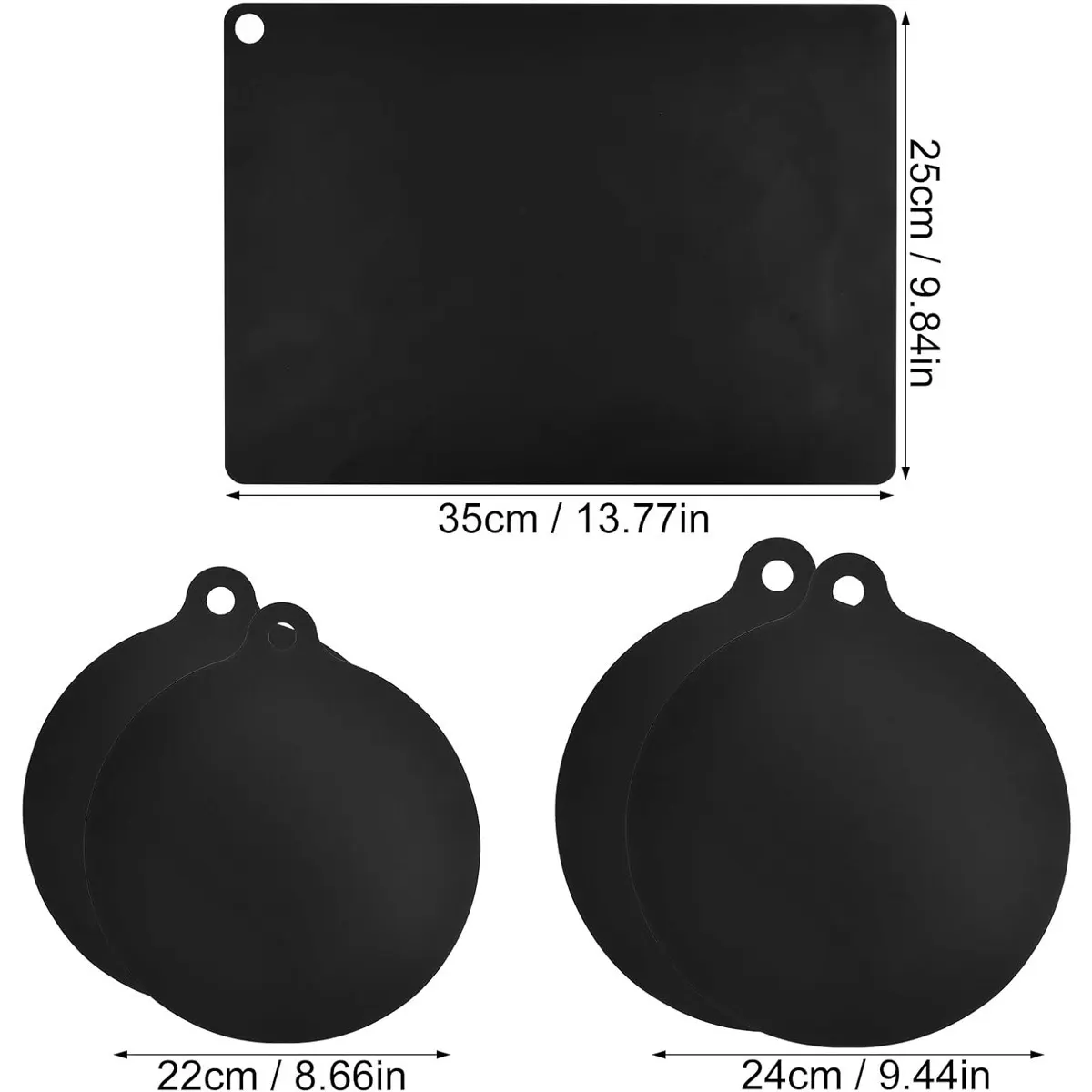
The documented set contains five black silicone pieces: three round mats measuring 22 cm, one round mat measuring 24 cm, and one rectangular mat measuring 35 × 25 cm. The stated thickness is 0.7 mm. Before ordering, measure the visible areas of your own hob rather than relying on the names of cooking zones. Note the diameter of each round area, the width and depth of any rectangular section, and the position of touch controls, edges and other fixed features. The aim is to establish whether the pieces cover the areas you want covered without obstructing anything your manual says must remain clear.

Mixed sizes can be useful in a kitchen with differently proportioned zones, but they do not mean every hob will be a match. Three identical 22 cm circles may suit several similarly sized areas, while the 24 cm circle gives a slightly larger option and the rectangle may suit a separate section. That is a dimensional description, not a promise of complete coverage. Draw the measurements on paper or use removable tape on a cool, switched-off surface to visualise the layout. Remove the tape before use and follow your appliance instructions throughout.

Separate confirmed material facts from unanswered performance questions

The listed material is silicone, and the set is black with a stated 0.7 mm thickness. Those are the useful facts available for comparing the product with other covers. An archived pack image also shows hanging holes, which may provide a way to store the pieces when they are not covering the hob. The supplied description does not provide a heat-resistance rating, dishwasher claim or third-party test result. It also does not establish that the mats are certified for use on a particular appliance brand or model.

Do not fill those gaps with assumptions. Silicone construction alone does not tell you the maximum temperature, whether a mat may be left under a hot pan, whether it can be washed in a dishwasher, or whether it will remain stable around an active induction zone. The documented use is as a cover when the hob is off. If your intended job is to cook on top of the mat, place it under cookware while a zone is active, or use it as a heat pad, the available product information does not confirm that suitability.

Check the mismatch between a removable cover and a cooking accessory

A removable cover has a different job from an accessory designed to sit on an active cooking surface. This five-piece set is described as a protector mat set for an induction hob, but the supplied facts only support treating it as a cover while the hob is switched off. They do not confirm heating performance, pan-detection compatibility, protection from hot cookware, resistance to melting or adhesion, or protection against every type of scratch. Keeping that distinction clear prevents a buyer from turning a limited product description into a wider safety or performance claim.

Consider who should not buy this set without further confirmation. It is not the right choice for anyone who needs a mat specifically rated for cooking temperatures, a verified dishwasher-safe accessory, or a cover guaranteed to work with a named hob model. It may also be unsuitable if your appliance instructions prohibit mats or if your surface dimensions do not correspond with the five supplied pieces. If you need a permanent countertop protector, a heat-resistant trivet, or an active-cooking liner, those are different requirements from covering a cool hob.

Use this pre-purchase sequence at the packing bench or kitchen worktop

Work through the decision in order, preferably with the hob completely cool and switched off. First, read the appliance manual and look for instructions about protective mats or covers. Second, write down the dimensions of the areas you want to cover. Third, compare them with three 22 cm round mats, one 24 cm round mat and one 35 × 25 cm rectangle. Fourth, confirm that your intended use is limited to covering the hob when it is off. Fifth, decide how you will remove, fold or store the pieces between uses.

A practical checklist is: appliance instructions checked; manufacturer permission or clarification obtained if the wording is unclear; round zone diameters measured; rectangular space measured; touch controls and required clearances considered; silicone material accepted; 0.7 mm thickness noted; no heat rating assumed; no dishwasher suitability assumed; no pan-detection claim assumed; and the 12-month retailer warranty information recorded. This checklist is deliberately conservative. It helps you decide from documented facts rather than from a photograph, a general assumption about silicone, or an expectation that all induction hobs accept the same accessories.

Plan placement and storage for a cool, switched-off hob

If your appliance instructions allow a cover and the dimensions suit your layout, treat placement as a simple surface-covering task. Make sure the hob is switched off and fully cool before placing a mat. Use the correct piece for the area you measured, keep controls and edges clear where required, and avoid dragging cookware across the covered surface. The product information does not describe a fixing system, adhesive backing or a cleaning method, so do not assume the mat will stay in position under movement or that a particular cleaning routine is approved.

Storage is part of the decision if you plan to remove the pieces before cooking. The pack image shows hanging holes, so you may wish to keep the mats together on a suitable hook or storage point, provided that arrangement is appropriate for your kitchen and does not create a hazard. Keep the pieces clean and dry according to the care information supplied with the order. Since dishwasher suitability is not documented, do not present machine washing as an established feature; check the current product instructions for any care guidance.

Make the next step a documented fit check

The next useful step is not to compare vague claims about protection; it is to compare your appliance instructions, measurements and intended use with the confirmed set details. You know the pack contains five black silicone pieces, the circular sizes are three at 22 cm and one at 24 cm, the rectangle is 35 × 25 cm, and the stated thickness is 0.7 mm. You also know that a 12-month retailer warranty is listed. Everything beyond those points, including heat rating, active-cooking suitability, pan detection and dishwasher use, remains unconfirmed in the supplied information.

If the manual permits a cool, switched-off cover and the dimensions fit the areas you want to cover, the set may be worth considering for that narrow purpose. If the manual rules out mats, your measurements do not work, or you need protection while cooking, stop and look for an option whose documented use directly matches that job. Keep a copy of the product details and your appliance guidance with your purchase records. That gives you a clear basis for deciding, without relying on unsupported promises about heating, safety or compatibility.