Choose a cover for your kitchen layout, not the product name

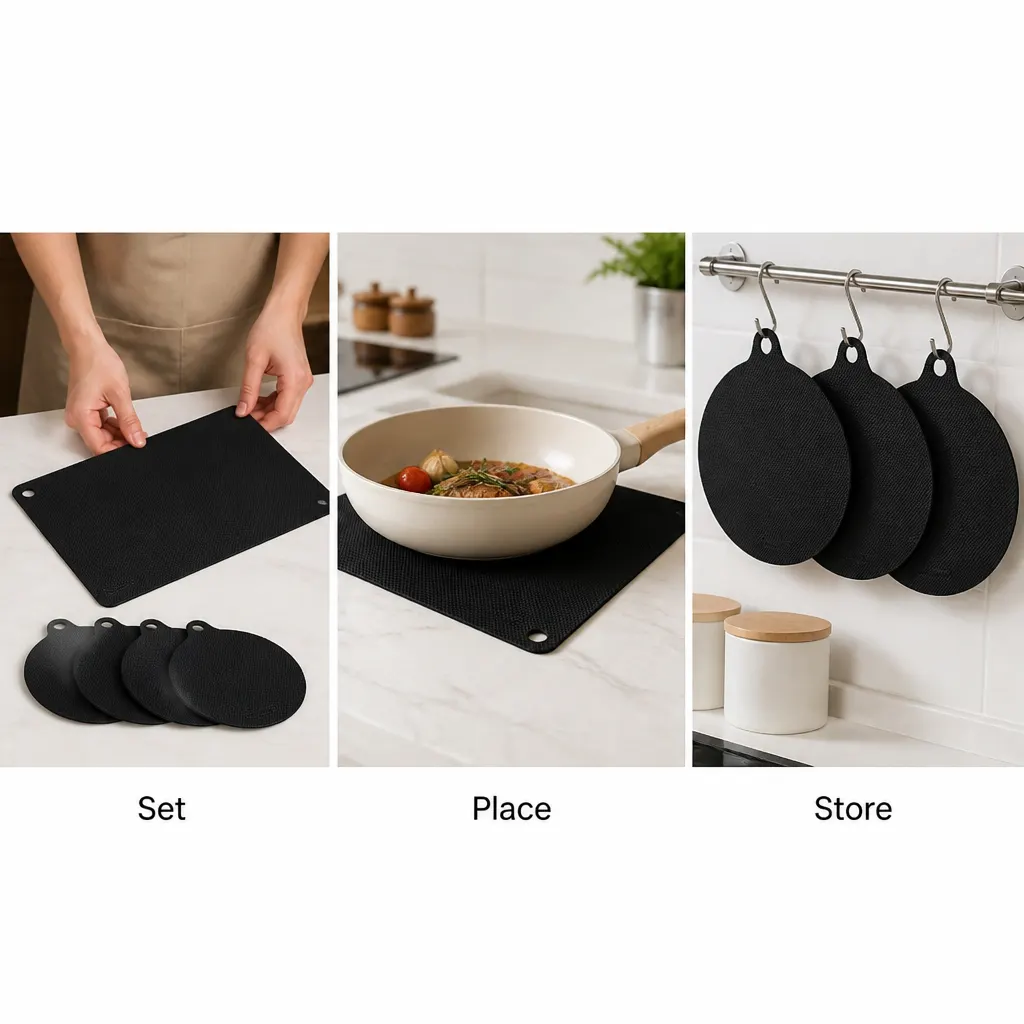
Product use sequence

For a practical glass induction hob cover, start by measuring the areas you want to cover while the hob is not being used. A mixed five-piece set containing three 22 cm round mats, one 24 cm round mat and one 35 × 25 cm rectangular mat may suit a kitchen where the cooking zones and surrounding glass have different shapes. Compare those dimensions with your own hob before ordering rather than assuming that a set described as suitable for common UK layouts will match every appliance.

This particular black silicone set is presented as a way to protect the glass surface between cooking sessions. That intended setting matters: it is a collection of separate, movable pieces rather than a single cover for the whole cooktop. It is most relevant to someone who wants to place mats over selected areas once cooking has finished and the hob is ready to be covered. Buyers seeking one uninterrupted sheet, a permanent fitted surface or an accessory to remain under cookware during heating need to make a different assessment.

Set the job in a working UK kitchen

In a typical UK kitchen, an induction hob often shares space with food preparation, washing up and the movement of pans or utensils. A dark glass surface can also remain visually prominent when the hob is not in use. Separate silicone pieces offer a straightforward way to cover selected zones between cooking sessions without turning the entire hob into another work surface. The documented pack gives you four round pieces for circular areas and one rectangle for a broader section of glass.

Think carefully about what you actually want the cover to do. If the aim is to cover the visible cooking zones after use, the round mats are the key pieces. If you also want to cover an adjacent rectangular area, the 35 × 25 cm mat may be useful. The published information does not position these pieces as chopping mats, extra food-preparation space or permanent fixtures. Keeping the task narrow makes it easier to judge whether the set fits your kitchen rather than expecting one accessory to perform several unrelated jobs.

Measure the glass surface and cooking-zone arrangement

Take measurements directly from the hob rather than relying on its nominal width. Record the diameter of each circular area you intend to cover, then measure any rectangular section that might take the larger mat. The set includes three circles measuring 22 cm across and one measuring 24 cm across. The rectangular piece measures 35 cm by 25 cm. Mark those dimensions on paper or use a tape measure over the switched-off surface to visualise how much glass each piece would occupy.

Next, check the spacing between controls, zone markings and the outer edge of the hob. A mat can match the diameter of a zone but still be inconvenient if it overlaps a touch-control panel or extends beyond the glass. Separate pieces give you freedom to change the arrangement, but their fixed sizes cannot be stretched into a different shape. If your hob has unusually large zones, closely grouped rings or a broad flexible cooking area, compare every measurement rather than treating the pack description as a universal fit statement.

Compare separate mats with whole-surface coverage

A five-piece set makes sense when you want to cover selected parts of the hob independently. You can use the 22 cm and 24 cm circles where their dimensions suit the layout, place the rectangle over another exposed area and remove or store pieces separately. This arrangement may also be easier to handle in a compact kitchen because no single piece is as large as the entire hob. The hanging holes provide a documented storage option when the mats are not on the glass.

The trade-off is that separate pieces will not create uninterrupted edge-to-edge coverage. Gaps may remain between circles, around control areas or near the perimeter, depending on the appliance. If your main requirement is to hide or cover the entire glass surface with one continuous piece, this pack format may not meet that expectation. Conversely, a whole-surface cover may be more material than you need if you only want to cover individual zones. Decide whether selective placement or complete coverage is the more important job before comparing products.

Check the documented material, thickness and pack contents

The published specification describes five black silicone mats, each about 0.7 mm thick. That is a thin, removable format rather than a rigid board or raised worktop cover. Black may visually suit a dark hob, although colour matching will depend on the appliance and surrounding kitchen. The useful point is that the pack composition is explicit: three 22 cm circles, one 24 cm circle and one 35 × 25 cm rectangle. Count the areas you intend to cover and make sure that combination is sufficient.

Do not fill gaps in the specification with assumptions. No product-specific heat rating, heated-cooking instructions, pan-detection performance or cleaning method is provided in the documented facts. Silicone as a general material does not establish how this particular accessory should behave under a hot pan or on an operating appliance. The stated purpose is protection between cooking sessions, so that is the sound basis on which to assess it. If you require another type of use, look for explicit documentation covering that use rather than inferring it from the material alone.

Avoid mismatches with cooking, trivets and worktop tasks

This set is unlikely to suit someone looking for a protector that has documented approval to stay beneath cookware while an induction zone is operating. The storefront information supports covering the surface between cooking sessions but supplies no heated-use instructions. A cautious setup is therefore to remove the pieces before operating the hob and use them only once cooking has finished and the surface is ready to be covered. Do not treat the absence of detailed restrictions as evidence that every other use is acceptable.

The product range is listed within kitchen tools and trivets, but that category placement does not by itself establish that these thin mats are suitable for supporting hot pans on a worktop. Nor are they described as chopping boards, pastry mats or extra preparation surfaces. They are also a poor match for buyers who need a single fitted cover, complete edge-to-edge coverage or sizes other than those stated. Recognising these limits before purchase is more useful than trying to adapt fixed pieces to a job that the published description does not support.

Use this kitchen fit-check before choosing the set

Work through this sequence at the switched-off hob. First, check size: compare three 22 cm circles, one 24 cm circle and one 35 × 25 cm rectangle with the areas you want covered. Second, check surface: identify whether you need selective zone coverage or one continuous cover. Third, check setup: map where each piece would sit without assuming it can be trimmed or resized. Fourth, check content: confirm that five pieces are enough for the number of areas you have identified.

Then check environment and aftercare. In the kitchen environment, decide where all five pieces will go during cooking so that removal does not create clutter around the hob. For aftercare and storage, note that the silicone mats have hanging holes, so a suitable hook or hanging point may keep them together between uses. No specific cleaning method is included in the published details, so do not assume a particular appliance or cleaning process is suitable. Finally, return to the intended job: removable protection between cooking sessions, not an undocumented heated-cooking or worktop role.

Take a measured next step at the hob

Before buying, draw a simple plan of your hob and label the spaces with their measurements. Place 22 cm circles on the plan three times, add one 24 cm circle and mark a 35 × 25 cm rectangle. This quick exercise will show whether the mixed pack covers the most important areas, leaves acceptable gaps and stays clear of any controls. It also prevents a common buying error: focusing on the overall number of pieces without checking whether their individual dimensions correspond to the glass you want to cover.

Choose the set if those fixed sizes suit your layout, you prefer separate black silicone pieces and your intended use is covering selected areas between cooking sessions. Keep comparing if you need one continuous surface, different dimensions or documented support for a task beyond that stated purpose. Once the fit is clear, plan a storage position using the hanging holes and make removal part of the kitchen setup before the hob is switched on. That measured approach gives you a more reliable answer than choosing a glass induction hob cover by appearance alone.